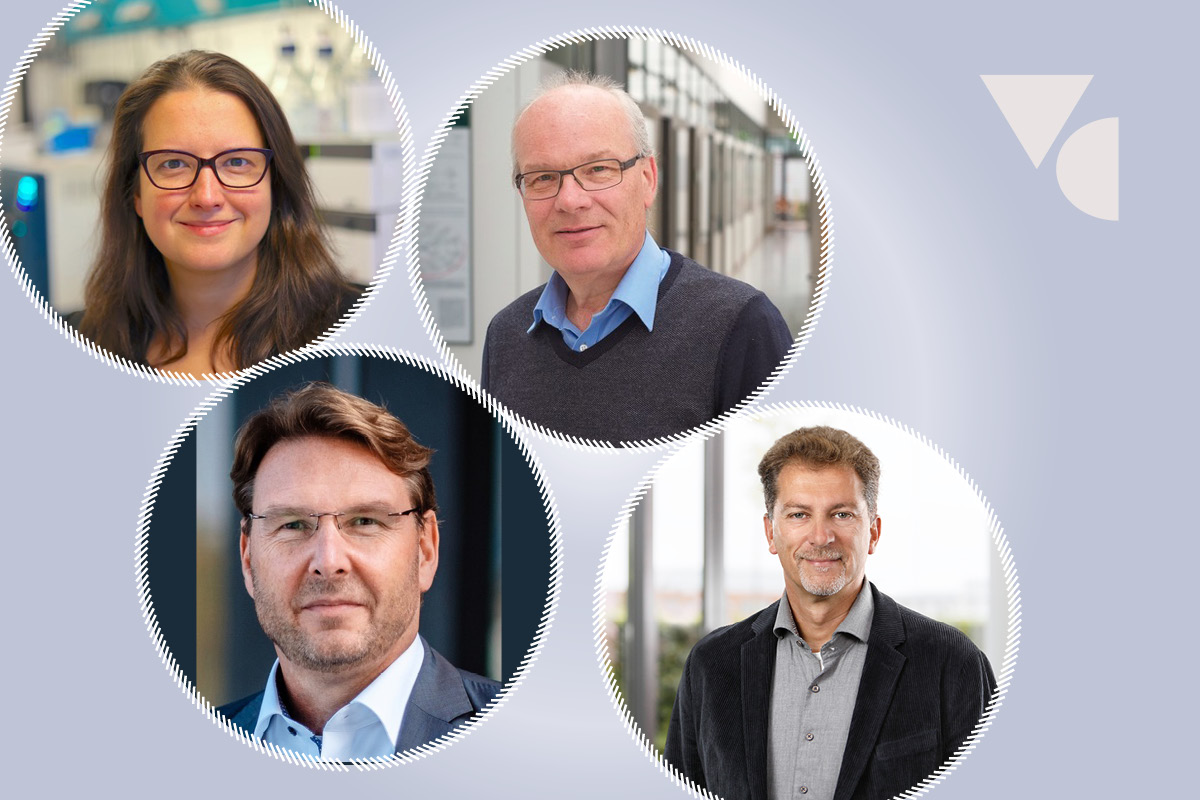
Bildnachweis: BMZ, MPI Dortmund, iDEL, KyDo.
Coal and steel have shaped Dortmund’s history – science and innovation are in- creasingly shaping its future. In the wake of structural change, a dynamic life sciences ecosystem has emerged in which cutting-edge research, drug discovery, and entrepreneurship are closely intertwined. The focus is on translating findings from basic research into marketable applications. The new Centre for Integrated Drug Discovery (ZIW) is regarded as a further milestone on this journey.
When the city of Dortmund was in search of alternative sectors for the future in the face
of the foreseeable decline of the coal and steel industry, the vision of establishing a life sciences hub was a bold one. Nevertheless, the course was set early on with the opening of the Technologie ZentrumDortmund (TZD) on the western outskirts of the city in 1985 and the Biomedizin Zentrum (BMZ), which was founded shortly afterwards as an incubator. ‘The ecosystem is now supported by several internationally renowned research institutions. Today, the science campus, situated in the immediate vicinity of Dortmund Technical University (TU Dortmund), is home to over 430 companies and around 21,000 employees,’ says Prof. Dr Herbert Waldmann, outlining the development. He is Director Emer- itus at the Max Planck Institute of Molecular Physiology, which is also based there. Furthermore, he is the representative for the city’s ‘Masterplan Science 2.0’ initiative, which is driving forward the restructuring of the economic landscape. ‘Our aim is to connect universities, non-university research, businesses, economic development agencies, and the wider community. Here, innovation arises from proximity – with short pathways between research and the market,’ says Waldmann. In fact, Dortmund has grown significantly over the years to become a strong hub in the field of drug discovery. ‘This is the new DNA of Dortmund as a research hub – where coal and steel once dominated, licensable drug candidates are now being developed for key health issues such as cancer, diabetes as well as cardiovascular and neurodegenerative diseases.’ The scientist does not shy away from comparing the region with major German life sciences hubs such as Munich, Berlin, or Heidelberg. ‘With our consistent focus on translation, we occupy a niche that is underdeveloped in Germany. Added to this are an excellent infrastructure and competitive cost structures – key ad- vantages that attract scientists as well as start-ups. This is all the more true since geopolitical changes have sharpened Europe’s profile as a resilient and highly qualified research region. Today, cost optimisation increasingly means choosing the right location, even within Germany.’
High-quality infrastructure as a key location advantage
The next stage of development is just around the corner: the Centre for Integrated Drug Discovery (ZIW) is set to officially open in October as an extension of the Biomedical Centre. ‘We are responding to the continuing high demand. Our focus is clearly on additional space for S1 and S2 use, complete with basic laboratory equipment, technical gases and pre-installed IT infrastruc- ture. The laboratory facilities are complemented by flexible office space and modern seminar rooms,’ explains Dr Joanna Stachnik, Head of the BMZ. A biochemist herself, she knows how rare such facilities are at fair terms. Thus, the expansion is far more than just a property project: it marks the next step in a strategy that is systematically expanding the campus along the value chain of drug development. Where research takes place, start-ups should also emerge – and, if possible, grow. ‘Even in the age of global digital collaboration, high-quality laboratory space remains a crucial location factor for innovative start-ups and SMEs in the fields of biomedicine and medical technology – ideally in the immediate vicinity of their research and other centres of scientific excellence.’ Further support comes from start-up competitions such as start2grow and networking initiatives such as the inno- club and the ‘3rd Wednesday’ events. ‘This is how success stories are written,’ says Stachnik. Protagen provides a prime example: the biotech company, founded in Bochum in 1997, moved into the BMZ in 2002 and found support there in the form of research, infrastructure, and networking, which gave a boost to its further development. The company that started out as an early tenant at BMZ has since developed into ProtaGene, a globally active specialist in protein analytics and molecular diagnostics. Stachnik adds: ‘KyDo Therapeutics and iDel Therapeutics are more recent spin-offs based at BMZ whose development we are following with great interest. They demonstrate that the next generation of promising biotech companies is already on the scene.
LDC bridges the gap between research and the pharmaceutical industry
The Lead Discovery Center (LDC), which is itself based at the Biomedizin Zentrum and was spun off from Max Planck Innovation in 2008, plays a central role in Dortmund’s life sciences ecosystem. Whilst almost all major German life sciences clusters boast excel- lent basic research, technology transfer, and incubators, the LDC combines industrial drug discovery, experienced pharmaceutical expertise and technology transfer under one roof. This process is further supported by the Khan technology transfer fund, which finances early-stage projects and is closely integrated with the LDC’s scientific work. This model gives Dortmund a clear unique selling point in the field of translational drug research. ‘As the only fully integrated research organisation of its kind in Germany, we maintain a “first-in-class” project portfolio comprising exclusively preclinical, pharmaceutical drug research projects at the interface between academic research and the pharmaceutical industry,’ con- firms Chief Operations Manager Anne-Kathrin Klebl. ‘In doing so, we specifically bridge the gap between basic research and drug development, which sets us apart from traditional research institutes and pharmaceutical companies. From medicinal chemistry to the protection of intellectual property – we offer expertise and infrastructure across all key disciplines of drug discovery. Furthermore, we can draw on the expertise of our extensive network in academia, industry, and the investment sector. Together, we find the solution for every project that best meets its specific challenges and current stage of development.’ According to Klebl, there are no comparable models in Germany – the nearest place where a similar approach can be found is at the Centre for Drug Design and Discovery (CD3) at KU Leuven in Belgium.
Success stories act as a magnet
A prime example of the LDC’s driving force is KyDo Therapeutics. Based at BMZ, the start-up develops highly selective drug candidates for cancer with the aim of reducing the side effects of current treatments. Its scientific roots lie in Prof. Dr Daniel Rauh’s department at TU Dortmund. In collaboration with the LDC, Taros Chemicals, and the Leibniz Research Centre for Working Environment and Human Factors (IfADo), the research was further developed until the company was spun off in 2024. Today, KyDo relies on a lean, international research model rather than establishing its own cost-intensive structures: depending on the devel- opment phase, the university, contract research organisations, and the LDC take on specific tasks. This is enabled by the infrastructure and expertise available at the site. KyDo has secured an initial funding round of EUR 4.45 million, backed by several investors, including TU capital, the seed fund of TU Dortmund, and local investor Vornvc. ‘Dortmund offers ideal conditions for the early stages,’ concludes co-founder and CEO Dr Matthias Stein-Gerlach. Another example is iDel, a company founded in 2025. It is developing a delivery platform for tumour therapy that enables active substances to be transported specifically into tumour cells. The aim is to enable new approaches to cancer therapy and to improve the efficacy of existing active substances. The spin-off process took place in a challenging market environment. Nevertheless, by the end of 2025, iDel had secured seed funding of EUR 9 million. Alongside a Swiss lead investor, several investors from North Rhine-Westphalia took part, including the LDC’s Khan Fund and the Gründerfonds Ruhr. For CEO Dr Marcus Kostka, it was not just the technology that was decisive. ‘You need a strong network,’ he says. ‘It helped immensely that we’re practically next door to the LDC at the Biomedizin Zentrum. We benefit every day from direct interaction with other drug discovery researchers, start-ups, service providers, and investors. The LDC has supported us with everything from organisational issues during the company’s forma- tion to access to investors. Hardly any other German life sciences hub combines translation, infrastructure, and financing as closely as Dortmund does.
Bottleneck in growth capital is to be resolved
Whilst life sciences start-ups often lack access to private venture capital, the funding landscape in Dortmund offers several options to start with. Within the LDC ecosystem, the Khan Technology Transfer Fund – a specialist fund for early-stage drug discovery projects – has been established. The Gründerfonds Ruhr II launched in 2024 with EUR 31 million, whilst Vornvc has been pooling more than EUR 42 million from savings banks, NRW. Bank, and regional entrepreneurs since 2025. NRW.Bank, TU capital, and regional family offices round out the offering. The real test, however, begins afterwards. ‘The bottleneck in the life sciences lies in securing the capital for competitive company building and scaling up,’ says Waldmann. For German biotech companies with international growth ambitions, such limitations can become a restraint driving them to places where large funding rounds, strategic pharmaceutical partners, and more special- ised investors are concentrated. This is precisely where the next stage of the LDC’s development comes in: in order to strengthen Dortmund’s profile as a leading location for translational drug discovery, the Khan Fund is to be further expanded with strategic investors. This shall enable even more drug candidate programmes to progress from basic research through to development readiness and further enhance Dortmund’s international standing. The foundations for this have been laid: Over the past two decades, Dortmund has built up a closely integrated ecosystem comprising research, infrastructure, translation, start-ups, and capital. The new Centre for Integrated Drug Discovery will fur- ther expand this locational advantage.