Bildnachweis: blende11 Fotografen.
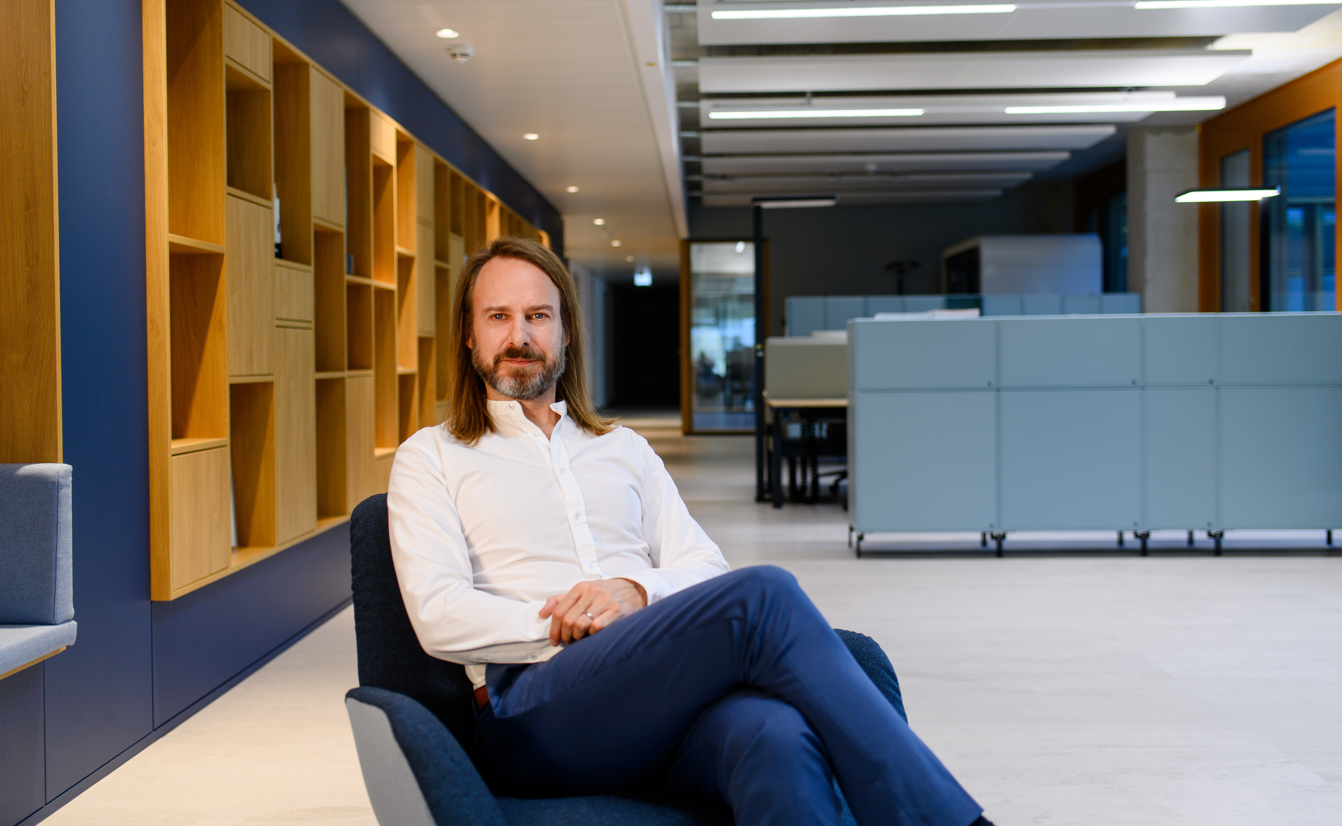
The life sciences sector is regarded as one of the most promising growth markets of the future. Germany is a hightech nation, and its economic strength is significantly influenced by its capacity for innovation. To compete globally with innovative products and services, effective technology transfer is of paramount importance. We explore the current state of the life sciences sector in Germany in an interview with Dr Philipp Baaske.
VC Magazin: Your company is one of the global market leaders in biophysical measuring instruments. NanoTemper was founded in 2008 as an LMU spin-off. What was the decisive factor that prompted you to transition from being a researcher to becoming a founder?
Baaske: For me, it was very personal. My mother had been diagnosed with breast cancer, and the drug that had saved her life, Herceptin (Trastuzumab), had been developed thanks to biotechnology. I realised that science is only truly powerful when it reaches patients. That thought never left me. In the lab, I loved the curiosity, the precision, the beauty of discovery. But I also saw the gap: brilliant ideas often stayed in publications, far away from people’s lives. I didn’t want to stop at discovery. I wanted to help turn discoveries into products everyone can use. That conviction grew stronger because of where I came from. I grew up in a small Bavarian village, in a family of craftsmen. My parents taught me that work should be practical, that it should serve people. Science fascinated me, but I felt restless: how much more powerful can our knowledge become when we bring it from the lab bench into everyone’s lives? So together with my co-founder, Dr Stefan Duhr, I took a leap. Two young scientists in a basement lab, building our first prototypes by hand. We had no venture capital, no roadmap, just determination – and a belief that what we built could make a difference. We were driven by the same stubbornness I saw in my parents’ workshop: if something didn’t work, you’d keep working on it until it did. Looking back, the decisive factor wasn’t a business plan or market analysis. It was the conviction that research should not end in the lab; it should cross the bridge to society. And entrepreneurship, for me, became the way to build that bridge.
VC Magazin: Your journey exemplifies the successful transfer of knowledge from the academic landscape to the private sector – essentially, moving from the laboratory to the customer. What were the most significant obstacles you had to overcome along this path?
Baaske: The biggest obstacles were not technical, they were human. As scientists, we were trained to go deep into experiments, but didn’t know how to speak with customers, negotiate contracts, or lead teams. I had to learn all of that from scratch. In the early days, we sold prototypes before the product was even ready. That forced us to move quickly, but it also taught us humility: customers expect reliability, not just clever ideas. Later, when growth outpaced our finances, we faced hard choices. Once, I had to let go of colleagues to save the company. It was one of the toughest moments of my life, but it made me realise that leadership is not about avoiding pain: it’s about carrying responsibility. And of course, there were countless smaller hurdles: convincing people to trust a young company, making payroll, fixing instruments by hand. But these obstacles became our training ground. If I had to name the most important lesson, it would be this: every challenge is a tuition fee for becoming an entrepreneur. You can’t skip the payments. You can only decide to keep learning and moving forward.
VC Magazin: From your current perspective, how can we enhance the transfer of knowledge and technology in Germany’s life sciences and medical technology whilst creating genuine added value for society?
Baaske: Everyone talks about funding – which is good because we need to improve it. I believe we should think beyond that. The focus must be on impact, not just on funding. In biotechnology, that means one thing above all: bringing innovation closer to patients and the doctors who care for them. We have excellent research and world-class scientists. The question is how quickly their discoveries travel from the lab into everyday medical practice. Stronger partnerships between universities, hospitals, and practicing physicians are essential. When researchers, clinicians, and doctors collaborate early, the journey from discovery to patient becomes shorter and more effective. Another key is encouraging scientists to take the step into entrepreneurship. Many hesitate, thinking they lack business skills. But what they really need is a supportive environment: mentors, role models, and the freedom to test their ideas. In the end, knowledge transfer is not about moving patents from one office to another. It’s about translating science into something that touches people’s lives and helps doctors treat their patients better. If we keep patients and physicians at the centre, everything else – investment, regulation, collaboration – will align more naturally.
VC Magazin: The scaling of research results in the private sector operates differently in
Germany and Europe compared to the USA. What lessons can we learn from the USA, and what should we approach differently?
Baaske: I admire the courage of the US ecosystem. Founders there often dream big, move fast, and find investors willing to back them early. That energy creates momentum and has given rise to many groundbreaking companies. Europe has strengths of its own. We are known for quality, precision, and trust. Customers value that we build things to last. Our challenge is to combine these strengths with greater speed and boldness. What I believe we should avoid is copying Silicon Valley’s shortterm mindset. Hype can create fast growth, but it can also destroy trust when promises are not kept. Instead, Europe has the chance to pioneer a different model: scaling responsibly, building profitable businesses, and creating impact that lasts decades, not just funding cycles. In short, we can learn confidence from the US, but we should stay true to our European DNA: patient, disciplined, and driven by long-term value.
VC Magazin: Since 1 October, you have served as Vice President for Entrepreneurship at Ludwig Maximilian University in Munich. How do you plan to specifically advance LMU in the areas of entrepreneurship and technology transfer?
Baaske: LMU is one of the world’s great universities, with 54,000 students and 18 faculties. It brings together excellence across all fields and research areas like medicine, physics, AI, law, economics, and the humanities. My duty is to make sure this richness finds its way into society; in the form of companies, knowledge, and empowered people. And it must find its way fast. A natural strength of LMU lies in deeptech, in life sciences, especially biotechnology, and in emerging fields such as artificial intelligence and quantum technologies. These are areas where groundbreaking research already exists, and where the impact on patients, industry, and society can be enormous. My focus is to strengthen these fields and to make traversing the paths from research to application smoother and faster. That means helping students and researchers with access to office and lab spaces, incubation programmes, funding opportunities, and strong partnerships with the relevant players in Munich and beyond. It means creating an environment where they can test bold ideas early, close to the customers; where they can learn from both success and failure, get advice from experienced founders and see entrepreneurship as an attractive path. Above all, I want to see the number of start-ups from LMU grow significantly – because when teaching, research, and entrepreneurship reach the same world-class level and start to reinforce each other, LMU will become even more so a place where ideas truly turn into impact. Not just for Munich, but far beyond.
VC Magazin: You have just published the book, ‘The Honorable Entrepreneur: Become Successful – Without Selling Your Soul,’ presented as a playbook for building a company on your own terms. Which tips from this book would you like to offer to founders and start-ups?
Baaske: If I had to share my most important tips, they would be the seven principles that carried me over the last 20 years: from a small basement lab to a global company. They are not theories; they are lived experiences:
- Build trust – or build nothing. Trust is the foundation with co-founders, employees, investors, and customers. Without it, no company can last.
- Put people first – always. Success is built by teams, not lone heroes. When you care for your people, they will carry the mission with you.
- Innovate for impact. Don’t build technology for its own sake. Ask yourself: does this make life better – for patients, for customers, for society?
- Scale smart and fast. Growth is important, but growth without discipline can destroy a company. Focused, profitable scaling creates resilience.
- Build a profitable business that lasts. Profitability is not an afterthought; it is what gives you freedom and independence.
- Execute your vision. Many founders get lost chasing shiny distractions. Stay focused. Execute what matters most.
- Give back. Share your experience, support others, and contribute to the ecosystem. True success means leaving something behind that outlives you.
- My message is simple: you can win in business without selling your soul. Profitability and principles are not opposites; they belong together. That’s the path of the honourable entrepreneur.
VC Magazin: Thank you for your insights!
About the interview partner:
Dr Philipp Baaske is the Co-Founder and Executive Chairman of NanoTemper Technologies, a Business Angel, and since October 2025, the Vice President for Entrepreneurship at Ludwig Maximilian University of Munich (LMU).