Bildnachweis: NUNOS, Nunos, Privat.
Using technology originally developed for space stations, start-up Nunos turns liquid manure into high-quality fertiliser. With its first pilot systems now in operation, the team is taking the next step towards market entry.
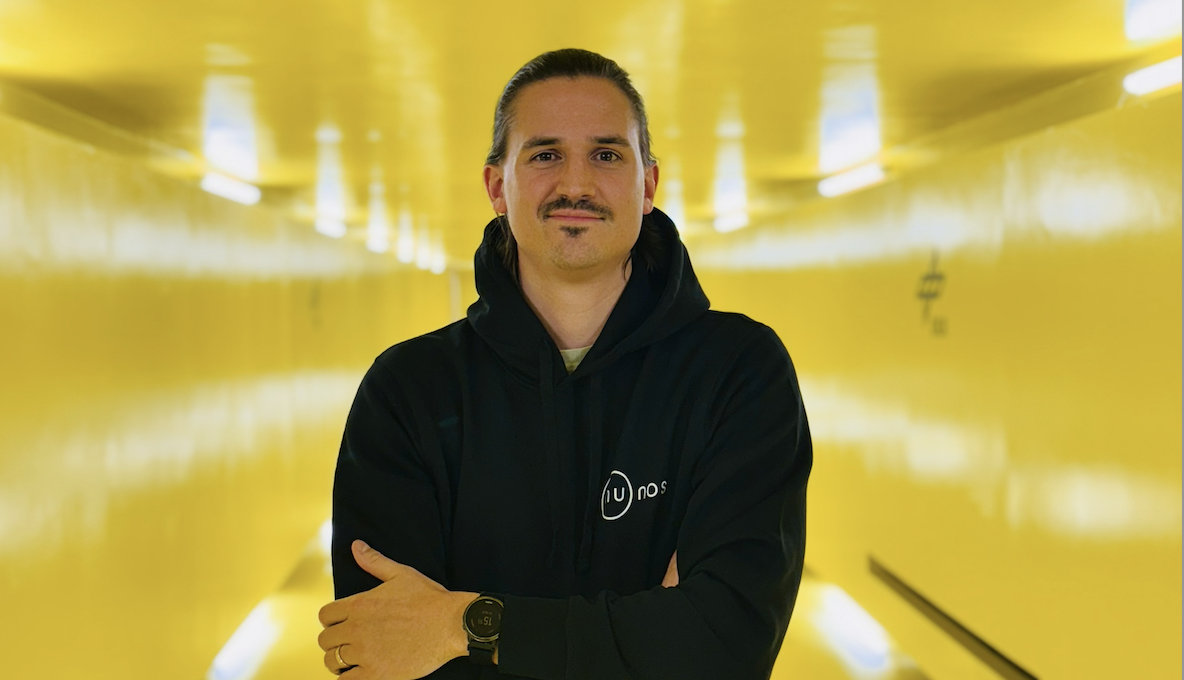
Farmers face two major challenges when it comes to fertilisation. In regions with intensive livestock farming, large volumes of liquid manure are generated, with excess nutrients exerting pressure on soil and groundwater. At the same time, many farms depend on large fertiliser manufacturers, raw materials, and global supply chains, exposing them to price volatility and supply risks. Start-up Nunos is about to launch a solution for this. Based in Hürth, Germany, the team is developing systems that enable farmers to produce their own fertiliser, reducing both environmental impact and external dependencies. The technological foundation comes straight from the space industry. Environmental engineer and CEO Tim Paulke first worked on closed-loop nutrient systems and urine treatment while working on his master’s thesis at the German Aerospace Center (DLR). At the time, the application was intended for lunar stations. In 2020, he initiated the transfer to the treatment of liquid manure and digestate in agriculture. Together with electrical engineer Fabian Mierbach, now CPO, he developed the prototype under the umbrella of DLR. They founded Nunos in May 2024, with biotechnologist Xenia Steurer later joining as co-founder and CTO.
Closed-loop system recycles and upgrades nutrients
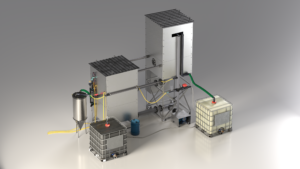
Nunos’ biological treatment systems are installed directly on farms or at biogas plants. ‘We help farmers and operators process and make better use of their own resources, enabling them to operate more efficiently,’ says Paulke. The technology is based on a microbiological process. Unlike with mechanical or thermal methods, its primary objective is not to neutralise or concentrate residual materials, but to recycle and upgrade their nutrients. The process is also designed to reduce nitrate losses and emissions. No additional process additives are required. ‘Our systems create a living ecosystem that thrives and adapts,’ Paulke explains. The result is a liquid fertiliser that can be applied more precisely and across a broader range of applications than untreated manure, including sensitive crops such as tomatoes, strawberries, and ornamental plants. More- over, the fertiliser has shown strong performance. In trials, Nunos has achieved yield increases of up to 20%. Its high utility could also enable farmers to develop new external uses and sales channels for their fertiliser, Paulke says. An unexpected proof point came in 2025, following a spontaneous appearance on German television show TV Total. Ahead of the broadcast, the team set up a B2C online shop for fertilisers within just a few days. After the episode had aired, around 300 orders came in.
Commercial systems to operate soon

For the initial financing, the team turned to business angels and NRW.Bank’s NRW.SeedCon programme. In summer 2026, this was followed by a pre-seed funding round totalling about EUR 500,000, with EUR 300,000 provided though NRW.Bank’s NRW.SeedCap programme. ‘Nunos helps farmers make better use of their nutrient surpluses, enabling a more sustainable agriculture and creating independency from expensive mineral fertilisers,’ says Stefan Dörpinghaus, investment manager at NRW.Bank, ‘and that makes a compelling investment case.’ The pilot system is already operating at a farm near Cologne, with two more units scheduled to follow this year. For market entry, Nunos is targeting farmers and operators of biogas plants of all sizes, starting with farms with around 50 cows to large-scale agricultural companies. Initially, Paulke and his team’s plans correspond to three system sizes. The first commercial systems are scheduled to go into operation in 2027.