Bildnachweis: Dr Philipp Schenk, McKinsey, T-Knife, FGK Clinical Research, Andera Partners, WuxiAppTec/Mikhail Glabets Photography.
Modern drug development is an inherently complex under-taking: bringing a new therapy from discovery to market requires highly specialised expertise, cutting-edge infrastructure, regulatory know-how, and significant financial endurance. As a result, biotech companies increasingly rely on external partners, making outsourcing a central pillar of how modern drug development is delivered.
For biotechs, the challenges begin early. Small teams, limited resources, and the lack of large-scale infrastructure make it difficult to build capabilities internally. Mean-while, research and development (R&D) is becoming increasingly complex, requiring specialised technologies and expertise ranging from high-throughput screening and in-vivo safety profiling to advanced manufacturing and regulatory strategy. Outsourcing allows biotech companies to access established platforms, experienced personnel, and global infrastructures immediately instead of building these capabilities from scratch. This not only reduces upfront capital spending but can also significantly speed up timelines. Contract research organisations (CROs) and contract development and manufacturing organisations (CDMOs) are crucial for drug development, indicated through strong market growth rates.
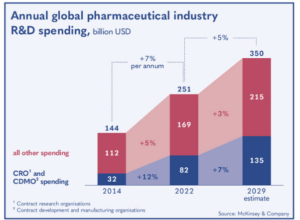
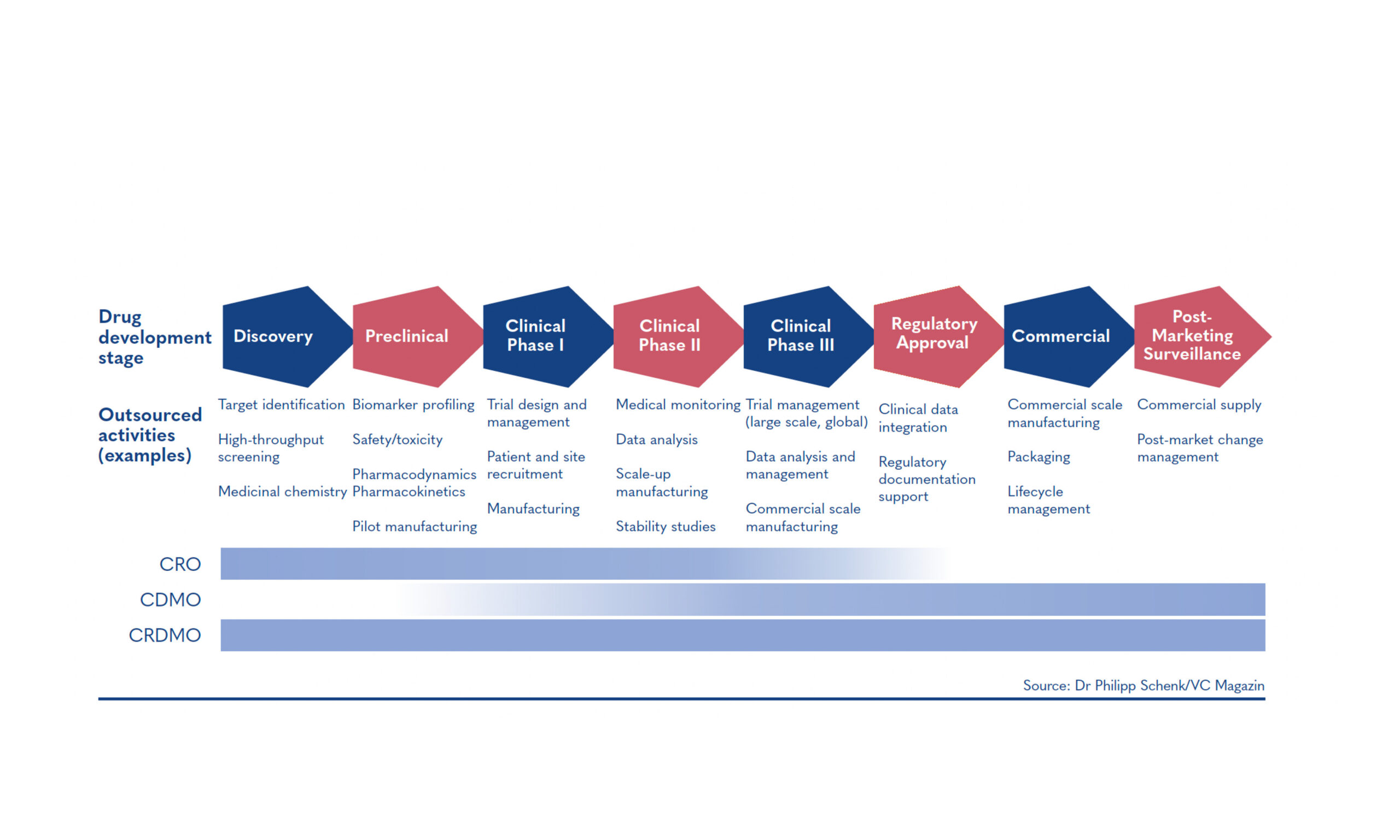
According to McKinsey, the annual global pharmaceutical R&D spending on CROs and CDMOs has increased dramatically, rising from roughly USD 32 billion in 2014 to USD 82 billion in 2022, with projections reaching up to USD 135 billion by 2029. Remarkably, spending on CROs and CDMOs is growing nearly twice as fast as overall R&D spending and is projected to further increase by up to 30% over the next five years. While CROs are broadly involved in early-stage activities such as target identification, safety profiling, and clinical trials, CDMOs support later stages. For many biotech companies, particularly in advanced modalities, outsourcing is no longer optional but operationally essential.

Dr Elisa Kieback, CTO and co-founder of Berlin- and Brussels-based T-knife, which develops supercharged ex-vivo and in-vivo cell therapies for solid tumours and is on track to become a clinical-stage company later this year, summarises the necessity for outsourcing manufacturing from an early stage: For a small biotech, it does not make sense to invest several tens of millions into building a manufacturing facility and to spend years setting it up before entering the clinic. That is why outsourcing manufacturing in early clinical development is the standard approach. Only once a product is closer to commercial stage does it make sense to invest in internal manufacturing infrastructure.‘
Managing expectations
Outsourcing in biotech goes far beyond simple service delivery. ‚Big pharma often wants pure execution. Biotech companies need much more interactive and flexible partnerships,‘ says Martin Krauss, Managing Director of the Munich-based CRO FGK Clinical Research GmbH. ‚Biotechs need partners that think proactively, fill gaps, and develop tailored solutions. We built our company around people with the mindset to solve complex problems collaboratively and help innovative projects succeed. Our goal is to be the best flexible partner for biotech companies,‘ Krauss adds.

This growing demand for strategic collaboration is also reflected by larger global providers. Dr Richard Connell, US & EU President of WuXi AppTec, describes how outsourcing relationships are increasingly built around long-term trust and operational integration: ‚Biotechs want a steady and experienced pair of hands: partners who have successfully managed complicated projects through various stages of R&D. They want partners who share the same sense of urgency, bring real regulatory and manufacturing know-how to a project, and are not just transactional service providers. The foundation of any long-term relationship is trust, and trust is built over time.‘
A key strategic advantage of outsourcing lies in capital efficiency and in the acceleration of value inflection points, both central to how investors evaluate companies. For Andera Partners, a private equity and venture capital firm active in life sciences and an investor in T-knife, outsourcing is part of how biotech execution is assessed Dr Olivier Litzka, partner in the firm’s life sciences team, explains: ‚When we conduct due diligence on a biotech company, the quality and management of external resources is a key parameter we seek to understand. In an industry that requires more and more special-isation, high-quality partnerships give us confidence in the overall project.‘ Increasingly, investors are favouring lean and asset-light models that avoid maintaining large permanent infrastructures, manufacturing facilities, or laboratory spaces before clinical validation has been achieved.
Finding the right partner
Matchmaking within the outsourcing industry is largely driven by a tightly intertwined ecosystem of conferences and networks. ‚We typically begin with a structured process, which allows us to shortlist potential partners,‘ explains Kieback. ‚This is followed by on-site audits and detailed evaluations. While expertise and speed are key criteria, the most important factor is finding a reliable, long-term partner, as these collaborations often continue across multiple clinical phases.
Dr Marleen Van Loenen, Executive Director at T-knife, adds: ‚When we expanded from ex-vivo into in-vivo cell therapy approaches for solid tumours, external specialists such as RoukenBio allowed us to test new ideas rapidly and generated early feasibility data before making larger internal investments. In that sense, they are not just extra capacity – they are a true extension of our R&D capabilities.‘ The importance of selecting the right partner is equally recognised on the service-provider side. ‚We don’t approach this with a pure sales mentality, ‚ says Krauss. ‚Of course, there are many CROs competing in the market, but not every project is necessarily the right fit for us. We want to be the best partner for the right projects.‘ In some cases, this may mean declining business opportunities. We don’t want to take on projects where we already know from the start that we cannot deliver our best performance,‘ Krauss adds. ‚Long-term reputation matters more than short-term growth.‘
Location matters
Frequently, certain CRO activities, such as chemical synthesis or preclinical animal studies, are outsourced overseas to benefit from lower costs. Depending on the drug modality, however, different aspects need to be considered. ‚For ex-vivo cell therapy manufacturing, geographical proximity becomes important. While production can in principle be done overseas and shipped, the logistics quickly become complex and expensive. A closer location is clearly an advantage,‘ says Kieback, explaining T-knife’s decision to partner with Munich-based Minaris Advanced Therapies, a CDMO closer to home. Martin Krauss, who is also chairman of the German CRO industry association (BVMA), warns that increasing globalisation in the sector can create quality risks if local regulatory experience is lacking. ‚Some European clinical trial submissions are now prepared by teams outside of Europe that have never actually worked within the European regulatory system – and naturally, that can impact quality.‘ In parallel, geopolitical uncertainty and supply-chain resilience are increasingly influencing outsourcing strategies across the industry. ‚The demand for regional manufacturing optionality is real and growing, so we are accelerating capacity and capability investment globally to meet that need,‘ says Connell.
Outsourcing it all?
Balancing outsourced capabilities with in-house expertise remains a key challenge. ‚As therapies become more complex, you increasingly need specialised external providers, but at the same time, you also need strong internal expertise to be able to guide development and interpret data,‘ says Kieback. While outsourcing reduces infrastructure costs, it also creates operational complexity. Contract negotiations, quality audits, and intellectual property (IP) protection can themselves become highly resource-intensive processes. Additionally, data security and IP considerations are a key concern given the inherently sensitive nature of the shared data. CROs address these concerns through robust quality systems: ‚Protecting our clients‘ IP is a top priority, and WuXi AppTec strictly adheres to all applicable data and IP protection laws, regulations, and industry standards in every jurisdiction in which we operate,‘ says Connell. ‚All our facilities and operations undergo regular oversight from customers, regulators, and third parties.‘
From vendors to strategic partners
Outsourcing is increasingly evolving from transactional vendor relationships toward integrated strategic partnerships. One example is the contract research, development and manufacturing organisation (CRDMO) model. ‚An end-to-end provider anticipates needs, speeds development and avoids costly delays,‘ says Connell. He describes WuXi AppTec’s platform as follows: ‚Our model helps start-ups, biotech companies, and large pharma plug in exactly the capabilities they need and then scale seamlessly from one stage to the next, instead of coordinating work across multiple vendors.‘ Litzka sees such integrated models as an attractive option: ‚It is a positive trend that providers such as WuXi AppTec offer comprehensive solutions for biotech companies,‘ he notes. ‚For traditional development programmes, this can indeed be a viable operating model. However, in many highly innovative companies, key competencies and technologies remain in-house because they form part of the company’s know-how and generate critical IP – and I believe this will remain the case.‘
Looking ahead
While artificial intelligence is accelerating drug discovery and reshaping the industry, the growing complexity of advanced therapeutics means specialised outsourcing partners will become even more important. ‚In cell therapies especially, I expect continued growth of the ecosystem, with more CDMOs and CROs emerging as the field expands and successful products reach the market,‘ says Kieback. The rise of the outsourcing industry has also attracted investor attention. While our Andera Life Sciences fund strategy does not include investments in CROs or CDMOs, I think it is a very interesting investment space,‘ notes Litzka. ‚Some of these companies are highly profitable and powerful businesses, which is why our colleagues from Andera MidCap and Andera Acto invest actively in the sector.‘ Yet the industry also faces mounting pressure. ‚We are seeing a market in which a few companies can still raise substantial funding rounds, while the broader biotech ecosystem remains underfunded,‘ says Krauss. He expects further consolidation across the outsourcing industry as competition intensifies and providers scale globally. Ultimately, outsourcing is no longer simply a support function. CROs and CDMOs are evolving into strategic infrastructure for modern drug development itself, and the ability to identify, integrate, and manage the right external partners may become a defining competitive advantage for biotechs.